Ceramic Microwave Components
Accuratus serves a broad spectrum of microwave component suppliers.
Ceramics are widely used in the industry and Accuratus has been an
active participant since its founding.
MW Power Tube Ceramics
Raw ceramic components and metallized hermetic ceramic components
suitable for brazed assembly are widely used in power tubes or
vacuum electron devices.
Collector ceramics require high dielectric strength and high thermal
conductivity. Significant heat is generated in the collector as the
kinetic energy of the electron stream is converted to heat. Getting
the heat out of the collector efficiently is critical to avoid
melting or severely damaging the collector assembly. Some of the
ceramics here serve as part of the vacuum envelope requiring
hermeticity also. The collector runs at several thousand volts below
ground potential. Electrical puncture of the ceramic can lead to
catastrophic device failure. Small discharges across the face of the
ceramic can disrupt the function of the device, rendering it
unusable in an application. Materials generally used in these
applications are beryllium oxide and aluminum nitride owing to their
excellent thermal conductivity, vacuum tightness and bulk and
surface dielectric properties. Proper attention to detail to prevent
compromise of these critical material characteristics is imperative
for collector ceramics and is a hallmark of Accuratus’ service to
the industry.
An electron gun is mounted at the end of the tube opposite the
collector. Requirements here are generally less demanding however,
the use of high quality hermetic metallized ceramics is important.
There is little heat developed here and voltages are low. Aluminum
oxide is generally the material of choice. The need to stack several
of these components with critical inter-electrode spacing requires
the precision machining capability of Accuratus and the careful
metallization of the components by our industrial partners.
RF windows are produced for coaxial and waveguide inputs and
outputs. The windows must be hermetic and are normally brazed to the
metal tube envelope. Consistent dielectric properties and strongly
adherent, vacuum tight metallizing are critical. Typical materials
of construction are beryllium oxide and aluminum oxide although
diamond windows for extreme power output are produced.
Loss elements for various tube types are produced. Ring shaped
components to damp oscillations in klystron cavities are tailor made
to customer specification. Severs and loss buttons to control cavity
Q, absorb reflections from impedance discontinuities and drop
interstage gain are made in volume quantities. Porous aluminum oxide
is used for low power, less demanding applications. Higher power
applications requiring tightly defined loss characteristics and
dielectric properties are fabricated in customer supplied silicon
carbide composite materials typically with oxides such as magnesia,
beryllia and alumina added to develop specific properties. Where
anisotropic material properties are a concern, Accuratus maintains
orientation with respect to raw material pressing direction.
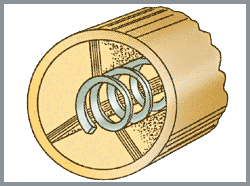
Helix traveling wave tubes are a special subclass of linear beam
tubes offering high gain over wide bandwidths. These tubes use
electrically long helical circuit elements mounted coaxially in a
metal tube. The electrical circuit is comprised of the helical metal
ribbon, ceramic supports and the metal outer tube all in a vacuum
environment. Often, many tubes are connected in parallel to generate
higher power in microwave systems thus requiring tight
specifications on output power and phase. Consistent dielectric
properties and tight geometric tolerances are necessary to assure
the tube meets output specifications. Low dielectric loss for good
efficiency and low dielectric constant to minimize loading of the
circuit are important material properties. The ceramic materials
must also be capable of transmitting significant heat from the
helix. Typically, materials used include beryllium oxide and boron
nitride with aluminum oxide used on some lower power low frequency
legacy devices.
Ceramic Heatsinks and Heat Spreaders
Heatsinks are used throughout the industry, particularly in the high
power segment, to transfer heat away from both active and passive
devices. Important material properties include good to excellent
thermal conductivity and good to excellent dielectric properties.
Materials in common usage include aluminum oxide, beryllium oxide,
boron nitride and aluminum nitride.
Common applications include:
— Resistor
supports in high power combiners
— Dielectric
supports for loads and terminations
—
Transistor and diode bases
— Conduction
cooled power tubes
— High power capacitor
supports
— Coil forms in helical resonators
— High power dielectric resonator supports
—
Substrates for hybrid microelectronics
— High
frequency resistor cores
Ceramic Isolator and Combiner Components
Accuratus precision machines customer specified or customer supplied
ferrite and dielectric components. Tightly held tolerances for
components used in the GHz range are routinely and economically
produced for end users as well as for other suppliers to the
industry.
Ceramic Dielectric Tuning Elements
Precision components are produced for a number of variable capacitor
manufacturers. Low and moderate dielectric constant materials having
low loss are used; typically fused silica and aluminum oxide. Tight
tolerances and uniform material electrical properties are mandatory
for easy assembly and repeatable final product specifications.
Customer specified dielectric resonator pucks are also fabricated
primarily for the high power terrestrial microwave communications
market. Specific high dielectric constant components are produced to
customer specification. Electrically insulating, low loss supports
for the dielectrics are also produced. These may be required to
minimize perturbation of the electromagnetic field in the vicinity
of the dielectric. In high power applications they must transfer
significant quantities of heat out of the dielectric to avoid tuning
drift, loss of circuit Q and perhaps avoid catastrophic failure of
the puck.
See also: Materials >
Aluminum Nitride
See also:
Materials > Boron Nitride
See also:
Materials > Fused Silica
See also:
Materials > Macor |