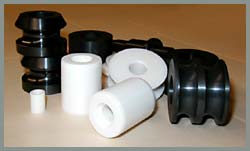
Metal Fabrication with Ceramics
A diverse range of custom products fabricated to meet your specific
designs are available in many materials. Many OEM equipment
manufacturers and end users are taking advantage of ceramics’
special properties.
Tube Mill Ceramic Components
Accuratus supplies critically toleranced new and remanufactured
ceramic rolls to a variety of mills.
Tube mills forming carbon and stainless tubing are using ceramics to
advantage in their weld boxes. Ceramic rolls are not wet by molten
metal splatter so build-up on the rolls is avoided or can be easily
removed. The rolls are electrically insulated protecting bearings
from stray weld currents. The rolls are easily cleaned and returned
to service using in-house techniques. When necessary the rolls can
be reground. The high hardness ensures long life of the rolls.
Typical materials of construction are aluminum oxide and silicon
nitride. High speed non-ferrous metal tube mills are also employing
ceramic rolls in the weld boxes for improved productivity and
product quality. The rolls are produced in silicon nitride. Their
high hardness, refractoriness, non-magnetic characteristics and
non-wetting by the copper based alloys permit their use in close
proximity to the induction coils and the hot zone within the weld
box. Very high production rates with extended preventative
maintenance schedules result
Ceramic sheaths to protect induction welding impeders are also
supplied. Highly refractory, wear resistant, non-wetting and thermal
shock resistant ceramics are used in this application. Typical
materials used include silicon carbide, silicon nitride and sialon.
Rod mills forming ferrous and non-ferrous metal rod are using
ceramic sleeves in their on-line eddy current testers. The hardness,
refractoriness and toughness of the ceramics all contribute to
extended lifetimes for the testers. The non-magnetic characteristics
of the ceramics make direct replacement of the thermoset and high
temperature thermoplastic components possible. Materials used
include silicon nitride and sialon. Rod mills producing copper rod
that is subsequently drawn to extremely fine diameter are using
zirconium oxide guide rolls to improve end product quality. The
non-contaminating hard ceramics do not contaminate the formed rod.
The result is substantially less breakage during the wire draw
process employed by the mill’s customers.
Ceramic Staking Dies
Zirconium oxide ceramic is being used to advantage for staking
captive fasteners and electronic fasteners. Lubricant usage is
reduced or eliminated. The hard, non-galling nature of the zirconia
reduces the need for lubricant while metal build-up on the staking
surfaces is minimized. Cosmetics of the finished product are
important. The fine grain structure of the ceramic makes it easy to
polish to finishes below 2 microinches-equivalent to those used on
metal and carbide dies. No reengineering is required. The toughness
of the material matches tungsten carbide allowing direct replacement
with zirconia in many applications. Finally, the corrosion
resistance of the zirconia allows easy and fast cleaning with
caustics and acids, thus eliminating the need for repolishing to
remove contamination as is typically done with metal and carbide
staking dies.
Welding and Brazing Ceramic Positioners/Fixtures
Precise positioning of components in spot, percussion and projection
welding lines can be achieved with sialon and silicon nitride
positioning components. Strong, thermal shock resistant, wear
resistant and non-wetting, they are ideal for fixturing parts
needing critical alignment. Precision tolerances are easily
maintained by Accuratus assuring you of high quality components that
work first time and every time.
Ceramics also find use as fixturing components in precision brazed
assemblies. They are not wet by the molten filler metal, they are
resistant to the corrosive action of the fluxes and maintain their
dimensions with repeated heating and cooling. Ceramics are found in
most types of brazing operations including furnace, torch and
induction. Materials found in these applications include aluminum
oxide, Macor, silicon carbide and silicon nitride.
See also: Materials >
Sialon
See also: Materials >
Silicon Carbide
See also:
Materials > Silicon Nitride
See also:
Materials > Zirconium Oxide |